


You type your main keyword into Google and scan the organic search results; there it is, a site you’ve never heard of sitting above you. Not the brand your sales team complains about, not the local shop down the street, some quiet publisher with a plain design and a page that answers the search better.
That’s the key: in SEO, your true search competitors are whoever wins the click for the same query. The good news is you can find your real rivals fast, tune out SERP noise (big directories, “best of” lists, and random giants), and walk away with a short list you can act on this week.
Why your “competition” list is probably wrong
In SEO competitor analysis, business competitors and SEO competitors overlap sometimes, but they’re not the same. A business rival sells what you sell. An SEO rival answers the same question your customer is asking, matching their user search intent.
That changes by topic, not by brand. A SaaS company might compete with other tools on target keywords like “best CRM,” but compete with blogs and YouTube on “how to clean up a customer list.” A dentist might face other practices for “dentist in Austin,” but face health sites for long-tail keywords like “toothache home remedy.”
Common traps make the list messy: checking only one or two keywords, mixing local and national results, overlooking paid search competitors, and panicking over huge sites that don’t match intent. If the search is “pricing,” a directory ranking high isn’t always a threat, it might just be a speed bump.

Photo by Monstera Production
The three kinds of SERP competitors you’ll see
- Direct: same offer, same buyer, same keywords, they can take the sale.
- Indirect: different offer, same problem, they can steal the research click.
- SERP features: maps, videos, forums, “best of” lists, they can take attention before links get a chance.
A simple process to find your real SEO competitors in under an hour
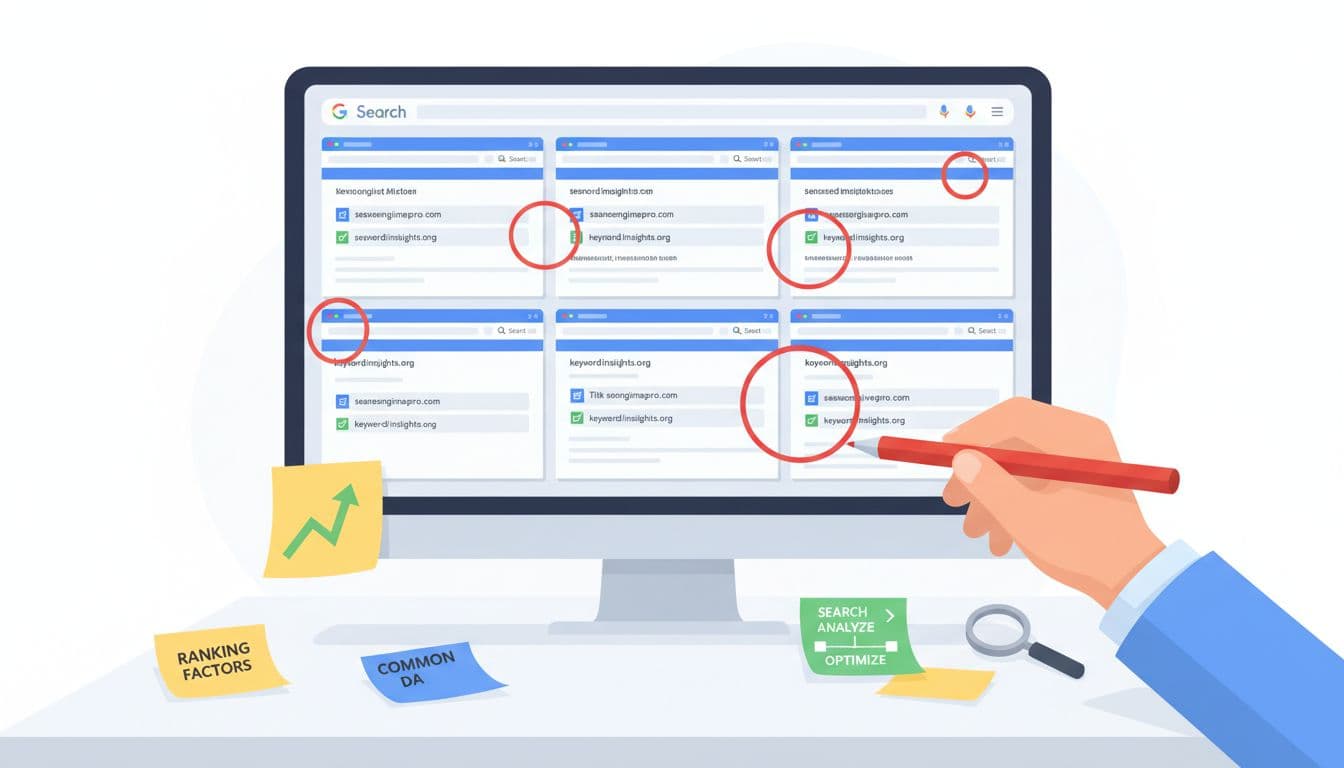
Repeating domains across searches are the rivals that matter most, created with AI.
To analyze search engine rankings and spot your true rivals, follow this straightforward process.
- Pick 10 to 20 target keywords across three buckets: money terms (buy, pricing), info terms (how, what), and comparison terms (best, vs). Focus on those with solid search volume.
- Search each keyword “clean.” Use incognito, log out, and set your location if you’re local.
- Record the top 10 domains for each keyword in a sheet to enable website traffic analysis.
- Circle the domains that show up again and again. In 2026, the most useful list is still the 3 to 5 repeating domains across your set.
- Build separate lists by topic clusters or site section, then refresh monthly and do a deeper review quarterly.
Quick filters that keep your list clean
Exclude false competitors like job boards, dictionary pages, one-off PDFs, and giant reference sites unless they match the same intent and show comparable keyword difficulty or domain authority. Use a simple test: “Would a visitor who lands there still want what I offer?” If yes, keep it. If no, move on.
Confirm competitors with tools, then learn what they’re doing better
Begin SEO competitor analysis by using one core competitor research tool (Semrush or Ahrefs) to confirm overlap, then add one supporting competitor research tool (SimilarWeb for market context, or Google Search Console for your own query trends). Check overlapping keywords, perform keyword gap analysis and content gap analysis to identify gaps you can fill, the pages bringing them organic traffic, and their backlink profile including referring domains that link to them but not you. Also examine what they’re doing better, such as a superior technical SEO audit, optimized internal linking structure, strong mobile-friendliness, or effective use of the skyscraper technique.
In 2026, watch more than rankings. Track visibility in SERP features and AI answers like AI Overviews, because those can change clicks even when positions look “stable.”
What to track weekly so you don’t fall behind
- Share of voice for your keyword set
- New top-10 keywords (yours and theirs)
- Pages gaining or losing positions (review historical data)
- New backlinks pointing to competitor pages
- New competitor content targeting your terms
- Changes in organic traffic for key pages
Conclusion
Real SEO competitors aren’t the brands that come up in meetings. They’re the repeat domains that keep taking the same clicks you want, across the same intent. This process delivers crucial market intelligence. Pick 15 target keywords today, log the top results, find the repeats, then choose your top three rivals. Copy down one of their pages and decide what you can improve on it this week to elevate your search engine rankings, address strategy gaps, and enhance competitive positioning.